


Hey there! As a supplier of the 250/3 Horizontal Pipe Stranding Machine, I've seen firsthand how the wire feeding speed can have a huge impact on the stranding quality. In this blog, I'm gonna break down what that impact is and why it matters to you.
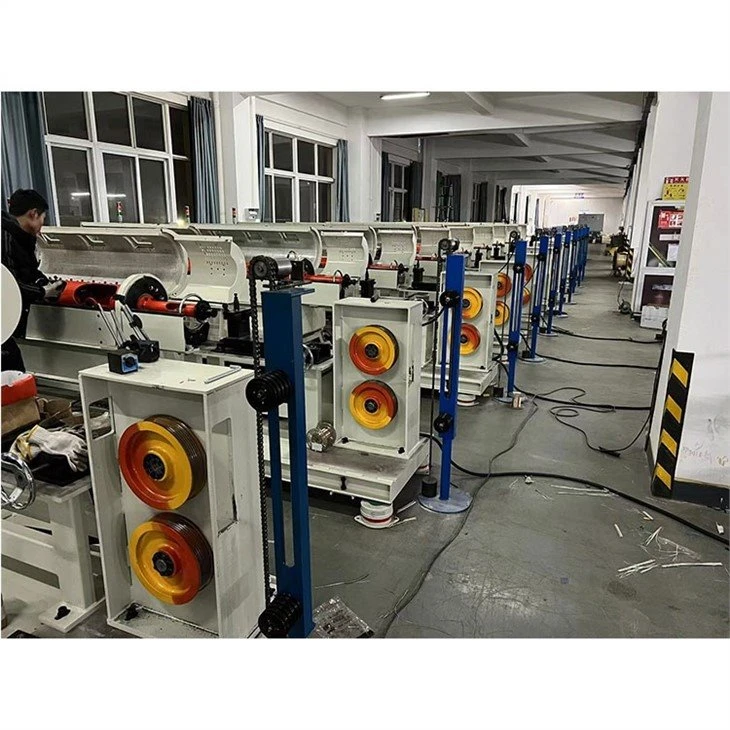
Let's start with the basics. The 250/3 Horizontal Pipe Stranding Machine is a piece of equipment used in the cable manufacturing industry. It's designed to strand multiple wires together to form a cable. The wire feeding speed refers to how fast the individual wires are fed into the stranding machine. This speed can vary depending on a number of factors, including the type of wire, the desired cable specifications, and the machine's capabilities.
One of the most significant impacts of wire feeding speed on stranding quality is the uniformity of the cable. When the wire feeding speed is consistent, the wires are more likely to be evenly distributed around the central core of the cable. This results in a cable with a more uniform diameter and better electrical properties. On the other hand, if the wire feeding speed is inconsistent, the wires may bunch up in some areas and be spaced too far apart in others. This can lead to a cable with an irregular diameter, which can affect its performance and durability.
Another important factor is the tension of the wires. The wire feeding speed can affect the tension of the wires as they are being stranded. If the speed is too fast, the wires may be under too much tension, which can cause them to break or stretch. This can result in a cable with weak spots or inconsistent electrical properties. Conversely, if the speed is too slow, the wires may be under too little tension, which can cause them to sag or twist. This can also lead to a cable with poor stranding quality.
The wire feeding speed can also impact the twist pitch of the cable. The twist pitch refers to the distance between two consecutive twists in the cable. A consistent wire feeding speed helps to ensure a uniform twist pitch, which is important for the cable's flexibility and mechanical properties. If the wire feeding speed is inconsistent, the twist pitch may vary along the length of the cable, which can affect its performance and make it more difficult to install.
In addition to these factors, the wire feeding speed can also affect the production efficiency of the 250/3 Horizontal Pipe Stranding Machine. A higher wire feeding speed generally means that more cable can be produced in a shorter amount of time. However, it's important to find the right balance between speed and quality. If the speed is too high, the stranding quality may suffer, which can lead to increased waste and production costs.
Now, let's take a look at some of the different wire feeding speeds and how they can impact the stranding quality.
Low Wire Feeding Speed
A low wire feeding speed can be beneficial in some situations. For example, when working with delicate or brittle wires, a slower speed can help to prevent breakage. It can also be useful when producing cables with a high number of wires, as it allows for more precise control over the stranding process. However, a low wire feeding speed can also result in a lower production rate and may not be suitable for high-volume manufacturing.

Medium Wire Feeding Speed
A medium wire feeding speed is often the most common choice for many cable manufacturers. It offers a good balance between speed and quality. At this speed, the wires are fed into the stranding machine at a rate that allows for consistent tension and uniform twist pitch. This results in a cable with good stranding quality and a reasonable production rate.
High Wire Feeding Speed
A high wire feeding speed can significantly increase the production rate of the 250/3 Horizontal Pipe Stranding Machine. However, it also comes with some challenges. At high speeds, it can be more difficult to maintain consistent tension and uniform twist pitch. This can lead to a decrease in stranding quality and an increase in waste. Therefore, it's important to ensure that the machine is properly calibrated and that the operators are trained to work at high speeds.
As a supplier of the 250/3 Horizontal Pipe Stranding Machine, we understand the importance of finding the right wire feeding speed for your specific needs. That's why we offer a range of machines that can be customized to meet your requirements. In addition to the 250/3 model, we also have other horizontal pipe stranding machines available, such as the 120/3 Horizontal Pipe Stranding Machine, the 200/18 Horizontal Pipe Stranding Machine, and the 200/3 Horizontal Pipe Stranding Machine. These machines offer different capabilities and features, allowing you to choose the one that best suits your production needs.
If you're interested in learning more about our horizontal pipe stranding machines or have any questions about wire feeding speed and stranding quality, don't hesitate to get in touch. We're here to help you find the right solution for your cable manufacturing needs. Whether you're a small-scale producer or a large industrial manufacturer, we have the expertise and the equipment to support you.
In conclusion, the wire feeding speed has a significant impact on the stranding quality of the 250/3 Horizontal Pipe Stranding Machine. By understanding how this speed affects the uniformity, tension, twist pitch, and production efficiency of the cable, you can make informed decisions about the optimal speed for your manufacturing process. Remember, finding the right balance between speed and quality is key to producing high-quality cables that meet your customers' expectations.
References
- "Cable Manufacturing Handbook" by John W. McBride
- "Wire and Cable Engineering" by R. Mark Irwin