


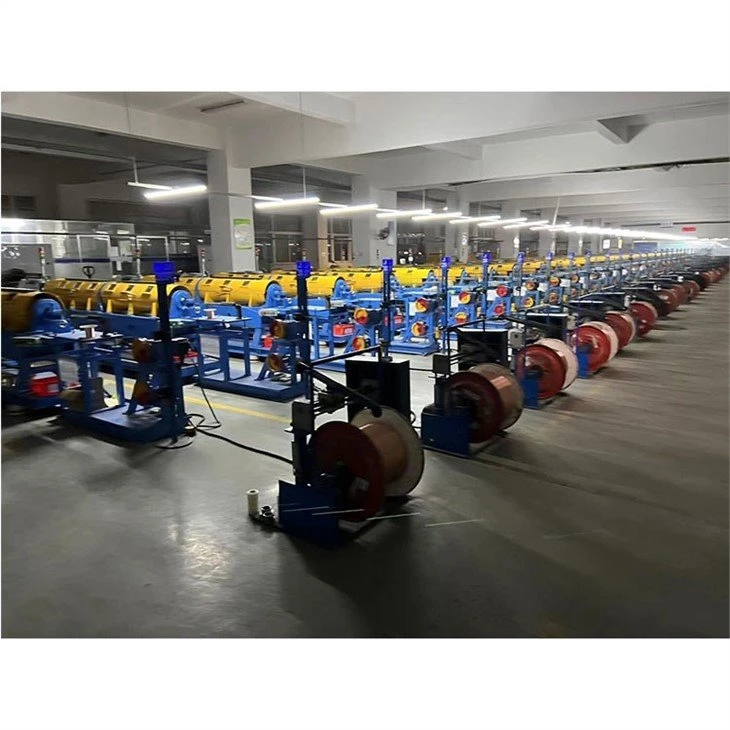
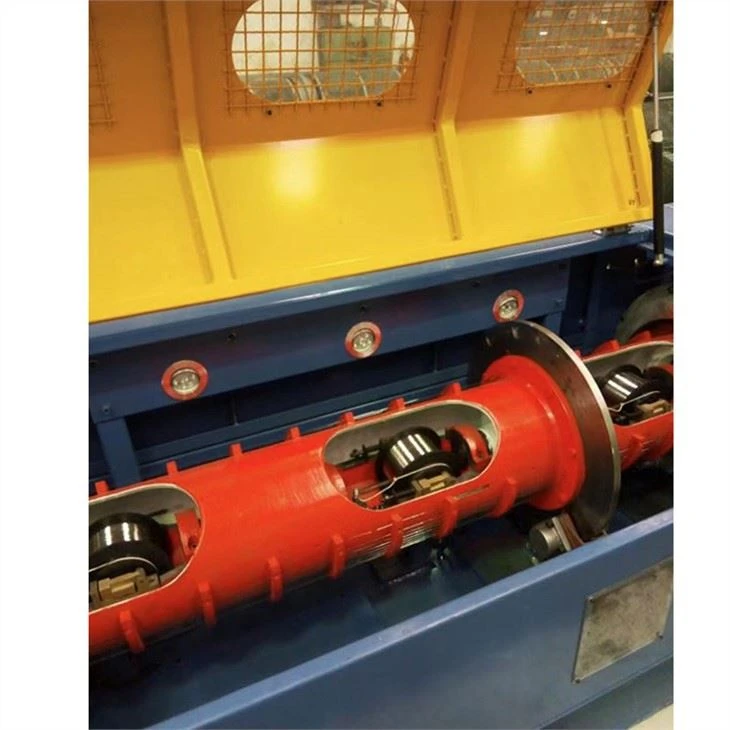
When it comes to the cable manufacturing industry, the 250/3 Horizontal Pipe Stranding Machine plays a crucial role. As a leading supplier of this machine, I understand the importance of ensuring high - quality stranding. In this blog, I will share some key methods to measure the stranding quality of the 250/3 Horizontal Pipe Stranding Machine.
1. Geometric Parameters
1.1 Stranding Pitch
The stranding pitch is one of the most fundamental geometric parameters. It refers to the distance along the axis of the stranded cable over which one complete turn of the strands occurs. A consistent stranding pitch is essential for the mechanical and electrical properties of the cable.
To measure the stranding pitch, we can use a simple measuring tool like a caliper or a pitch gauge. First, mark a starting point on the stranded cable. Then, carefully count the number of strand turns and measure the corresponding axial distance. The stranding pitch (P) can be calculated by dividing the measured axial distance (L) by the number of turns (n), i.e., (P=\frac{L}{n}).
Deviations in the stranding pitch can lead to uneven stress distribution in the cable, which may cause premature failure. For the 250/3 Horizontal Pipe Stranding Machine, the specified stranding pitch should be strictly adhered to according to the cable design requirements.
1.2 Outer Diameter
The outer diameter of the stranded cable is another important geometric parameter. An accurate outer diameter ensures proper fitting in connectors and conduits and affects the cable's overall performance.
We can use a micrometer or a laser - based diameter measuring device. Take multiple measurements at different positions along the cable length to account for any possible variations. If the outer diameter is too large, it may cause difficulties in installation; if it is too small, the cable may not provide sufficient protection for the inner conductors.
For the 250/3 Horizontal Pipe Stranding Machine, the outer diameter tolerance should be within a certain range specified by the cable standard. Regular checks of the outer diameter during the stranding process can help detect any issues with the machine's operation, such as improper tensioning of the strands.
2. Tensile Properties
2.1 Tensile Strength
Tensile strength is the maximum stress that a cable can withstand while being pulled before it breaks. A high - quality stranded cable should have sufficient tensile strength to withstand the mechanical forces it may encounter during installation and use.
To measure the tensile strength, we use a tensile testing machine. A sample of the stranded cable is clamped at both ends of the testing machine, and a gradually increasing tensile force is applied until the cable breaks. The tensile strength ((\sigma)) is calculated by dividing the maximum load ((F)) by the cross - sectional area ((A)) of the cable, i.e., (\sigma=\frac{F}{A}).
The 250/3 Horizontal Pipe Stranding Machine should be able to produce cables with tensile strength that meets the relevant industry standards. If the tensile strength is lower than expected, it may indicate problems such as poor strand bonding or incorrect stranding process.
2.2 Elongation at Break
Elongation at break is the percentage increase in the length of the cable when it breaks under tensile load. It reflects the cable's ductility and ability to deform without breaking.
During the tensile test, we measure the original length ((L_0)) of the cable sample and the length ((L_1)) at the moment of break. The elongation at break ((\epsilon)) is calculated as (\epsilon=\frac{L_1 - L_0}{L_0}\times100%).
Proper elongation at break is important for cables, especially those used in applications where they may be subjected to bending or stretching. The 250/3 Horizontal Pipe Stranding Machine should produce cables with appropriate elongation at break values, which can be adjusted by optimizing the stranding process parameters.
3. Electrical Properties
3.1 DC Resistance
DC resistance is a key electrical property of a cable. It affects the power loss and signal transmission efficiency. A lower DC resistance is generally desired for better electrical performance.
We can use a Wheatstone bridge or a digital multimeter to measure the DC resistance of the stranded cable. The measurement should be taken at a specified temperature, as the resistance of the cable is temperature - dependent.
For the 250/3 Horizontal Pipe Stranding Machine, ensuring a consistent and low DC resistance is crucial. Variations in the stranding quality, such as uneven strand distribution or poor contact between strands, can lead to increased DC resistance.
3.2 Capacitance
Capacitance is another important electrical property, especially for cables used in high - frequency applications. It is related to the cable's ability to store electrical energy between its conductors.
To measure the capacitance, we use a capacitance meter. The capacitance value should be within the specified range according to the cable design. Deviations in capacitance can affect the signal propagation characteristics of the cable, such as signal distortion and attenuation.
The 250/3 Horizontal Pipe Stranding Machine should be capable of producing cables with stable capacitance values. Factors such as the spacing between strands and the dielectric material used can influence the capacitance, and the stranding process should be optimized to control these factors.
4. Surface Quality
4.1 Surface Smoothness
A smooth surface of the stranded cable is important for aesthetic reasons and also for reducing friction during installation. Rough surfaces can cause damage to the cable's outer sheath and may also affect its long - term performance.
We can visually inspect the cable surface or use a surface roughness measuring instrument. Any scratches, bumps, or unevenness on the surface should be minimized. The 250/3 Horizontal Pipe Stranding Machine should be equipped with proper guides and tensioning devices to ensure a smooth stranding process and a high - quality cable surface.
4.2 Strand Arrangement
The proper arrangement of strands on the cable surface is also crucial. Strands should be evenly distributed and not overlap or cross each other in an irregular way.
Visual inspection is usually sufficient to check the strand arrangement. Irregular strand arrangement can lead to uneven stress distribution and affect the cable's mechanical and electrical properties. The 250/3 Horizontal Pipe Stranding Machine should be adjusted to ensure a regular and uniform strand arrangement.
5. Comparison with Other Machines
As a supplier, we also offer other models of horizontal pipe stranding machines, such as the 165/6 Horizontal Pipe Stranding Machine, the 165/12 Horizontal Pipe Stranding Machine, and the 50/6 Horizontal Pipe Stranding Machine. Each machine has its own characteristics and is suitable for different cable production requirements.
When measuring the stranding quality, we can also compare the performance of the 250/3 Horizontal Pipe Stranding Machine with these other models. This comparison can help us identify areas for improvement and optimize the stranding process for each machine.
Conclusion
Measuring the stranding quality of the 250/3 Horizontal Pipe Stranding Machine involves a comprehensive assessment of geometric, tensile, electrical, and surface properties. By carefully monitoring these parameters, we can ensure that the cables produced by the machine meet the highest quality standards.
If you are in the cable manufacturing industry and are looking for a reliable horizontal pipe stranding machine, our 250/3 Horizontal Pipe Stranding Machine is an excellent choice. We are committed to providing high - quality machines and excellent after - sales service. Contact us for more information and to discuss your specific requirements for cable production.
References
- Groover, M. P. (2010). Fundamentals of Modern Manufacturing: Materials, Processes, and Systems. Wiley.
- Neubert, L. (2004). Cable Production Technology. Hanser Publishers.