


Hey there! As a supplier of the 80/12 Horizontal Pipe Stranding Machine, I'm super stoked to break down how this amazing piece of equipment works. So, let's dive right in!
The Basics of the 80/12 Horizontal Pipe Stranding Machine
First off, what's a horizontal pipe stranding machine for? Well, it's all about twisting multiple wires or strands together to form a single cable or rope. This process is crucial in industries like telecommunications, power transmission, and even in making high - strength ropes for marine applications.
The "80/12" in the name of our machine has specific meanings. The "80" usually refers to the maximum diameter (in millimeters) of the finished cable or rope that the machine can produce. And the "12" represents the number of pay - off spools, which are the holders for the individual wires or strands that will be stranded together.
Working Principle Step by Step
1. Pay - off Section
The whole process kicks off at the pay - off section. Here, we have 12 spools, each holding a single wire or strand. These spools are carefully mounted on the machine, and they're designed to release the wires smoothly and at a consistent tension. The key here is to ensure that each wire is fed into the stranding process without any kinks or tangles. If a wire gets stuck or has a kink, it can mess up the entire stranding process and lead to a faulty cable.
2. Wire Guiding and Tensioning
Once the wires are released from the pay - off spools, they pass through a series of guides and tensioning devices. These guides are like little traffic cops, making sure that each wire is in the right position and moving in a straight line towards the stranding area. The tensioning devices, on the other hand, keep the wires taut. If the tension is too loose, the wires might bunch up or not twist properly. If it's too tight, the wires could break. It's all about finding that sweet spot.
3. Stranding Head
Now, this is where the magic happens - the stranding head. The stranding head is the heart of the machine. It rotates at a high speed, and as it does, it twists the 12 wires together. The rotation of the stranding head creates a helical pattern in the wires, which gives the finished cable its strength and flexibility. The speed of the stranding head can be adjusted depending on the type of cable you're making and the desired stranding pitch (the distance between two consecutive twists).
4. Layering and Bundling
In some cases, you might want to create a cable with multiple layers. Our 80/12 Horizontal Pipe Stranding Machine can handle that too. After the first layer of wires is stranded, additional layers can be added. The machine is designed to ensure that each layer is laid on top of the previous one in a precise and uniform manner. This is important because it affects the overall performance of the cable, such as its electrical conductivity or mechanical strength.
5. Take - up Section
Once the cable is fully stranded, it moves to the take - up section. Here, the finished cable is wound onto a large spool. The take - up spool rotates at a speed that matches the production speed of the cable. This way, the cable is wound neatly and tightly onto the spool, ready for storage or further processing.
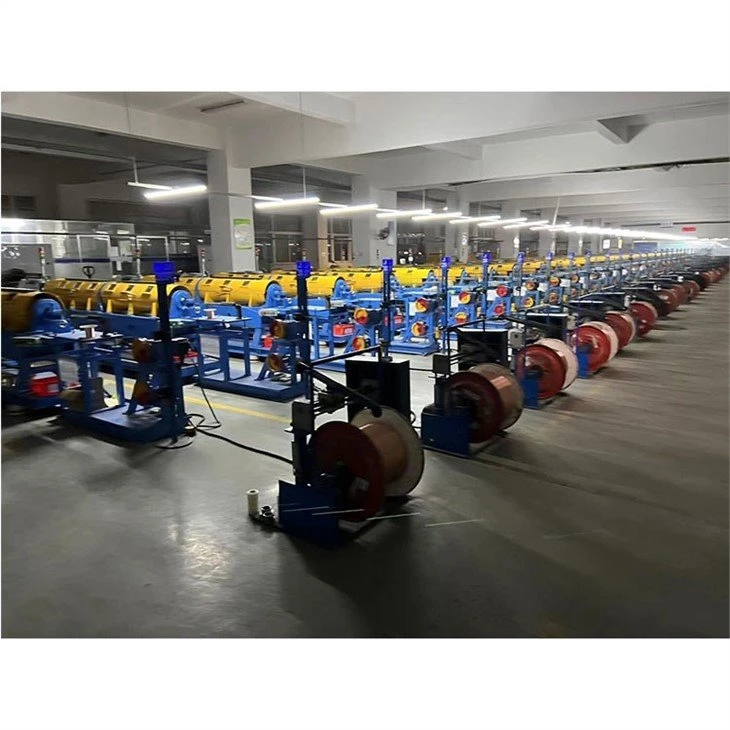

Why Our 80/12 Horizontal Pipe Stranding Machine Rocks
Now, you might be thinking, "There are other stranding machines out there. Why should I choose yours?" Well, let me tell you a few reasons.
First of all, our machine is built with high - quality materials. The pay - off spools, stranding head, and take - up spool are all made to last. This means less downtime for maintenance and more time for production.
Secondly, it's super easy to operate. We've designed the controls to be user - friendly, so even if you're new to cable stranding, you'll be up and running in no time.
And finally, we offer excellent after - sales support. If you ever run into any issues or have questions about the machine, our team of experts is just a phone call away.
Other Related Machines
If the 80/12 Horizontal Pipe Stranding Machine isn't quite what you need, we also have other models available. For example, we have the 165/6 Horizontal Pipe Stranding Machine, which is great for producing larger - diameter cables with a different number of strands. There's also the 165/12 Horizontal Pipe Stranding Machine, which offers more pay - off spools for more complex cable designs. And if you need to make even larger cables, our 250/9 Horizontal Pipe Stranding Machine might be the perfect fit.
Let's Talk Business
If you're in the market for a high - quality horizontal pipe stranding machine, I'd love to hear from you. Whether you're a small cable manufacturer or a large industrial company, our 80/12 Horizontal Pipe Stranding Machine can meet your needs. We can have a detailed discussion about your specific requirements, and I'm sure we can find the best solution for you. So, don't hesitate to reach out and start the conversation about your next cable - making project.
References
- Industry Handbook on Cable Manufacturing
- Technical Manual of Horizontal Pipe Stranding Machines