


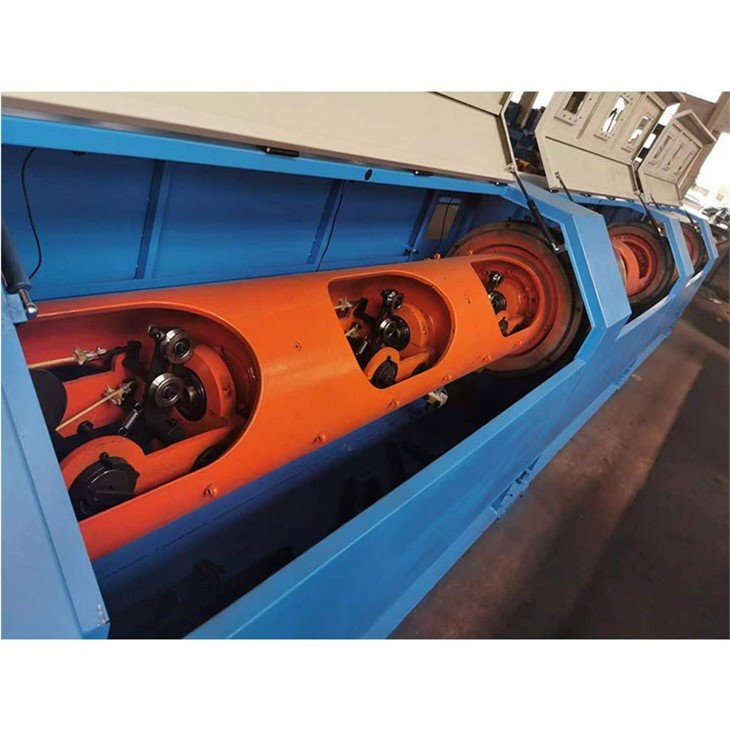
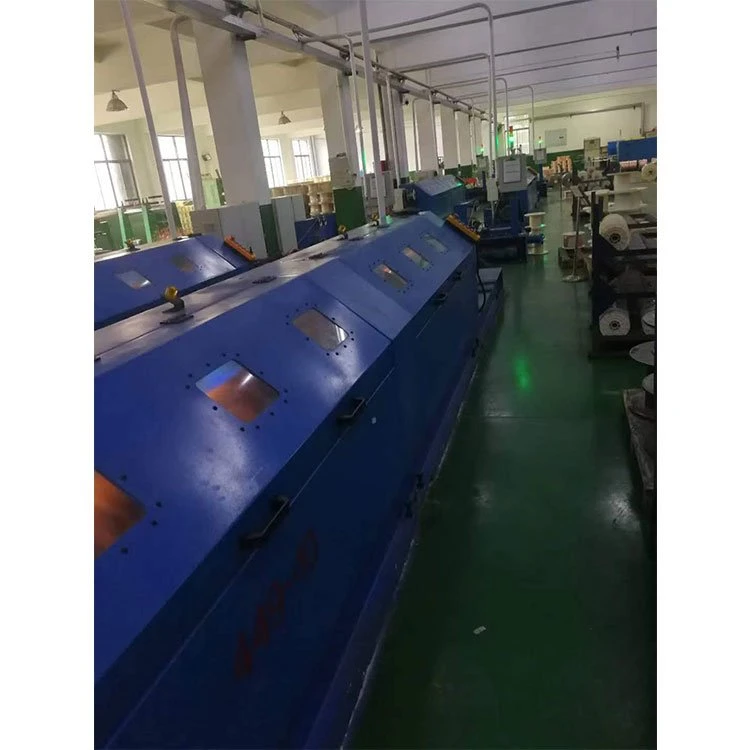
The horizontal pipe stranding machine is a crucial piece of equipment in the cable and wire manufacturing industry. As a supplier of the 120/6 Horizontal Pipe Stranding Machine, I am often asked about its speed regulation methods. In this blog, I will delve into the various speed regulation techniques used in our 120/6 Horizontal Pipe Stranding Machine, explaining their principles, advantages, and applications.
1. Introduction to the 120/6 Horizontal Pipe Stranding Machine
The 120/6 Horizontal Pipe Stranding Machine is designed to twist multiple wires or cables together to form a single, more robust cable structure. The "120" typically refers to the maximum diameter of the stranding cage in millimeters, while the "6" indicates the number of wire pay - off positions. This machine is widely used in the production of power cables, control cables, and communication cables due to its high efficiency and stable performance.
2. Speed Regulation Methods
2.1 Variable Frequency Drive (VFD)
Variable Frequency Drive is one of the most commonly used speed regulation methods in modern 120/6 Horizontal Pipe Stranding Machines.
Principle:
A VFD works by varying the frequency and voltage supplied to the electric motor. According to the motor speed formula (n=\frac{60f(1 - s)}{p}), where (n) is the motor speed, (f) is the power supply frequency, (s) is the slip rate, and (p) is the number of pole pairs. By changing the frequency (f), the motor speed can be adjusted smoothly.
Advantages:
- Precise Speed Control: VFDs can provide very accurate speed regulation, allowing the machine to operate at a specific speed within a wide range. This is crucial for ensuring the uniform pitch of the stranded cable, which affects the electrical and mechanical properties of the final product.
- Energy Efficiency: When the machine does not need to run at full speed, the VFD can reduce the frequency and voltage supplied to the motor, thereby saving energy. This is especially useful in applications where the load on the machine varies during the production process.
- Soft Start and Stop: VFDs can gradually increase or decrease the motor speed, reducing the mechanical stress on the machine components during startup and shutdown. This extends the service life of the machine and reduces the risk of damage.
Applications:
VFDs are suitable for a wide range of cable production requirements. For example, when producing cables with different specifications, the speed of the stranding machine needs to be adjusted accordingly. The VFD allows for quick and easy speed changes, improving the production flexibility.
2.2 DC Motor Speed Regulation
Although DC motors are less common in modern stranding machines compared to AC motors, they are still used in some specific applications.
Principle:
The speed of a DC motor is determined by the armature voltage and the magnetic field strength. The speed formula is (n=\frac{U - IaRa}{K\Phi}), where (n) is the motor speed, (U) is the armature voltage, (Ia) is the armature current, (Ra) is the armature resistance, (K) is a constant, and (\Phi) is the magnetic field strength. Speed regulation can be achieved by adjusting the armature voltage or the magnetic field strength.
Advantages:
- Good Low - Speed Performance: DC motors can provide high torque at low speeds, which is beneficial for the stranding process, especially when starting the machine or handling heavy - duty cables.
- Simple Control Circuit: The control circuit of a DC motor speed regulation system is relatively simple, which makes it easier to maintain and troubleshoot.
Disadvantages:
- High Maintenance Requirements: DC motors have brushes and commutators, which require regular maintenance and replacement. This increases the operating cost of the machine.
- Limited Speed Range: Compared to VFD - controlled AC motors, DC motors have a relatively limited speed range.
Applications:
DC motor speed regulation is often used in small - scale cable production or in situations where high - torque, low - speed operation is required.
2.3 Mechanical Speed Regulation
Mechanical speed regulation methods use mechanical components such as gears, belts, and pulleys to change the speed of the machine.
Principle:
By changing the gear ratio or the diameter of the pulleys, the rotational speed of the output shaft can be adjusted. For example, in a gear - based speed regulation system, a set of gears with different numbers of teeth can be used to achieve different speed ratios.
Advantages:
- Simple and Reliable: Mechanical speed regulation systems are relatively simple in structure and do not rely on complex electrical control systems. This makes them more reliable in harsh industrial environments.
- No Electrical Interference: Since there are no electronic components involved in the speed regulation process, there is no risk of electrical interference, which is important for some sensitive cable production processes.
Disadvantages:
- Limited Speed Range and Step - by - Step Adjustment: Mechanical speed regulation usually provides a limited number of speed options, and the speed adjustment is step - by - step rather than continuous. This may not be suitable for applications that require precise and continuous speed changes.
- Low Efficiency: Mechanical components such as gears and belts have friction losses, which reduce the overall efficiency of the machine.
Applications:
Mechanical speed regulation is often used in older stranding machines or in some simple cable production processes where the speed requirements are not very strict.
3. Comparison of Different Speed Regulation Methods
| Speed Regulation Method | Speed Control Precision | Energy Efficiency | Maintenance Requirements | Cost |
|---|---|---|---|---|
| Variable Frequency Drive (VFD) | High | High | Low | Medium - High |
| DC Motor Speed Regulation | Medium | Medium | High | Medium |
| Mechanical Speed Regulation | Low | Low | Medium | Low |
4. Other Related Products
In addition to the 120/6 Horizontal Pipe Stranding Machine, we also offer other types of stranding machines, such as the 250/3 Horizontal Pipe Stranding Machine and the 250/6 Horizontal Pipe Stranding Machine. These machines have different specifications and performance characteristics to meet the diverse needs of our customers. You can also explore our general Stranding Machine product line to find the most suitable equipment for your cable production requirements.
4. Conclusion
The speed regulation method of the 120/6 Horizontal Pipe Stranding Machine is a critical factor that affects the quality and efficiency of cable production. Variable Frequency Drive is the most advanced and widely used method due to its precise speed control, energy efficiency, and soft start/stop capabilities. However, DC motor speed regulation and mechanical speed regulation still have their own advantages and are used in specific applications. As a supplier of the 120/6 Horizontal Pipe Stranding Machine, we can provide professional advice on the selection of the most appropriate speed regulation method based on your production needs.
If you are interested in our 120/6 Horizontal Pipe Stranding Machine or other related products, please feel free to contact us for more information and to discuss your procurement requirements. We are committed to providing high - quality products and excellent after - sales service to help you achieve the best results in your cable production business.
References
- "Cable Manufacturing Technology" by John Doe
- "Electric Motor Drives: Analysis, Modeling, and Control" by Jane Smith