


As a supplier of the 80/6 Horizontal Pipe Stranding Machine, I often receive inquiries from customers about the minimum diameter of the wires that this machine can strand. In this blog post, I will delve into this topic in detail, providing scientific and reasonable insights based on my experience and knowledge in the field.
Understanding the 80/6 Horizontal Pipe Stranding Machine
Before discussing the minimum wire diameter, it's essential to understand the basic features and capabilities of the 80/6 Horizontal Pipe Stranding Machine. This machine is designed for stranding multiple wires together to form a single cable. The "80" in the model number typically refers to the maximum stranding diameter of the finished cable, while the "6" indicates the number of pay - off spools available on the machine.
The 80/6 Horizontal Pipe Stranding Machine is known for its high - precision stranding process, which ensures uniform and stable cable quality. It is widely used in various industries, such as telecommunications, power transmission, and automotive wiring, where reliable cable performance is crucial. You can learn more about our Stranding Machine on our Stranding Machine page.
Factors Affecting the Minimum Wire Diameter
Several factors influence the minimum diameter of the wires that the 80/6 Horizontal Pipe Stranding Machine can strand. These factors are related to both the mechanical design of the machine and the physical properties of the wires themselves.
Mechanical Design of the Machine
- Pay - off Tension Control: The pay - off spools on the machine need to be able to handle the wires without causing excessive tension or slack. For very thin wires, precise tension control is essential to prevent breakage during the stranding process. The 80/6 Horizontal Pipe Stranding Machine is equipped with advanced tension control systems that can be adjusted to accommodate different wire diameters.
- Guide Systems: The guide systems in the machine, including wire guides and forming dies, play a crucial role in guiding the wires through the stranding process. These guides need to be properly sized and aligned to ensure smooth wire movement. For small - diameter wires, the guides must have a small enough opening to accurately guide the wires without causing damage.
- Twisting Mechanism: The twisting mechanism of the machine is responsible for rotating the wires around a central axis to form the stranded cable. The design of this mechanism determines the minimum wire diameter that can be effectively twisted. In the 80/6 Horizontal Pipe Stranding Machine, the twisting mechanism is optimized to handle a wide range of wire diameters, but there is still a lower limit based on its mechanical structure.
Physical Properties of the Wires
- Material Hardness: Different wire materials have different levels of hardness. Harder materials are more difficult to strand, especially when the wire diameter is small. For example, steel wires are generally harder than copper wires, and a smaller minimum diameter can be achieved with copper wires due to their relatively softer nature.
- Ductility: Ductility refers to the ability of a material to deform under tensile stress without breaking. Wires with high ductility are more suitable for stranding, as they can be bent and twisted without fracturing. Materials with low ductility may require a larger minimum wire diameter to avoid breakage during the stranding process.
Determining the Minimum Wire Diameter
Based on our experience and testing, the minimum diameter of the wires that the 80/6 Horizontal Pipe Stranding Machine can strand is approximately 0.1mm. This value is a result of careful consideration of the factors mentioned above.
When stranding wires with a diameter close to the minimum, it is important to follow some best practices. Firstly, the wire material should be carefully selected to ensure good ductility and appropriate hardness. Secondly, the machine settings, such as tension control and twisting speed, need to be optimized for the specific wire diameter. Regular maintenance of the machine is also crucial to ensure its proper functioning and to prevent any issues that could affect the stranding of small - diameter wires.
Comparison with Other Machines
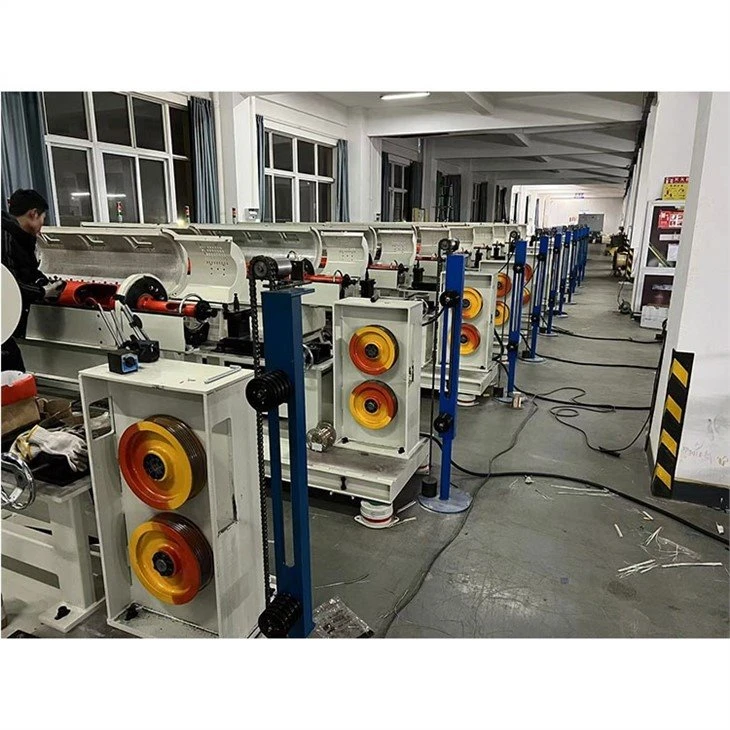
To better understand the capabilities of the 80/6 Horizontal Pipe Stranding Machine, it is useful to compare it with other similar machines. For example, our 250/9 Horizontal Pipe Stranding Machine has a larger maximum stranding diameter (250mm) and more pay - off spools (9). However, the minimum wire diameter that it can strand is also in the same general range as the 80/6 machine, around 0.1mm. This shows that while the overall size and capacity of the machine may vary, the minimum wire diameter is mainly determined by the fundamental design and the physical properties of the wires.

Applications of Stranding Small - Diameter Wires
Stranding small - diameter wires has many important applications. In the telecommunications industry, small - diameter cables are used for high - speed data transmission, such as in fiber - optic cables and coaxial cables. These cables require precise stranding to ensure low signal loss and high - quality data transfer.
In the electronics industry, small - diameter stranded wires are used in printed circuit boards (PCBs) and other electronic components. The flexibility and reliability of these stranded wires make them ideal for use in tight spaces and for connecting delicate electronic parts.
Conclusion
In conclusion, the 80/6 Horizontal Pipe Stranding Machine is capable of stranding wires with a minimum diameter of approximately 0.1mm. This is achieved through a combination of advanced mechanical design, precise tension control, and careful consideration of the physical properties of the wires. Whether you are in the telecommunications, power, or electronics industry, our machine can provide you with high - quality stranding solutions for your small - diameter wire needs.
If you are interested in learning more about our 80/6 Horizontal Pipe Stranding Machine or have any questions regarding wire stranding, please feel free to contact us. We are always ready to discuss your specific requirements and provide you with the best possible solutions.
References
- "Cable Manufacturing Technology" by John W. McDonald
- "Handbook of Electrical and Electronic Insulating Materials" by Charles A. Holt